
Recombinant Mouse IL-15 protein (rFc Tag)
Species
Mouse
Purity
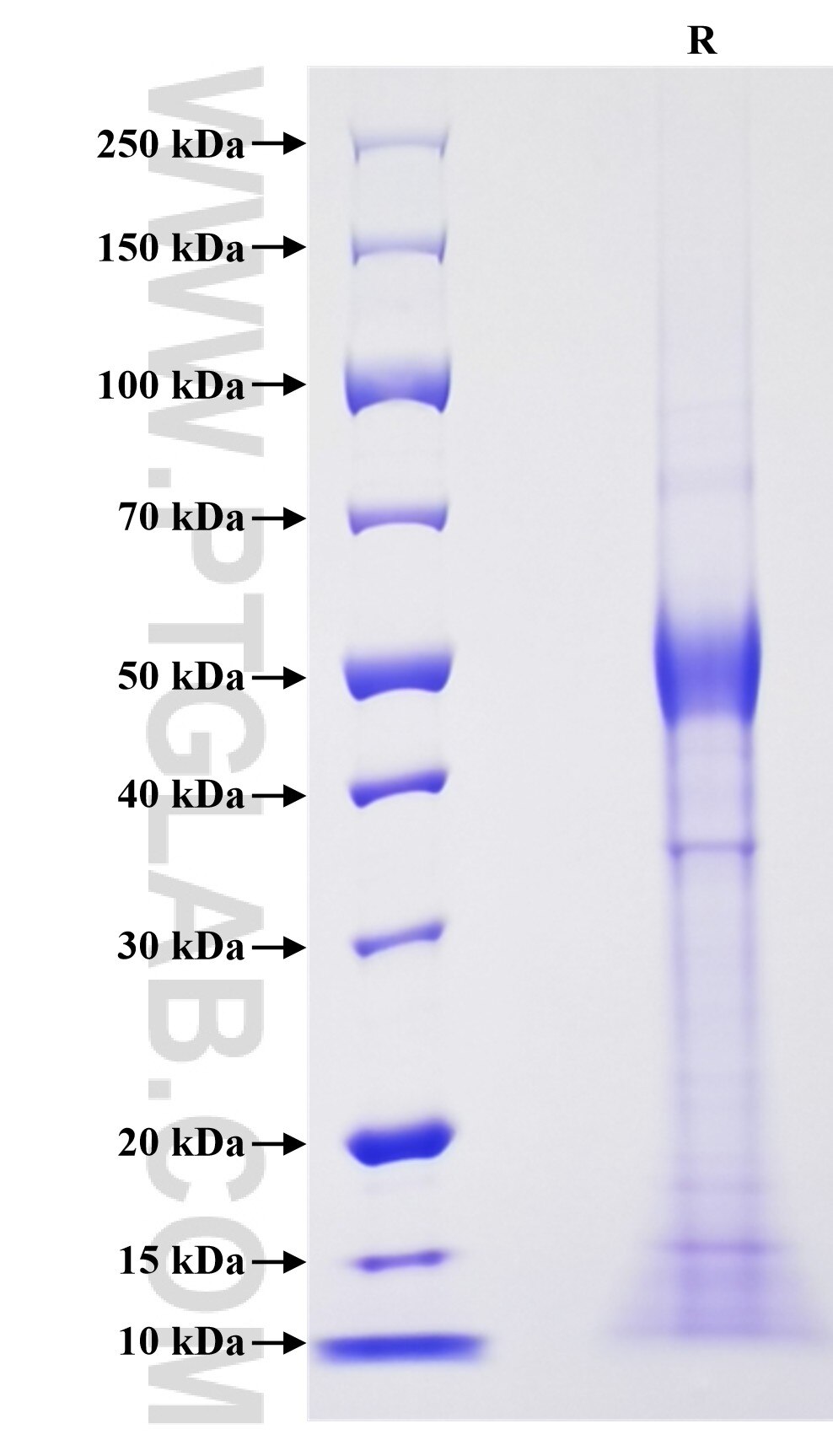
>80 %, SDS-PAGE
Tag
rFc Tag
Activity
not tested
Cat no : Eg2179
Validation Data Gallery
Product Information
| Purity | >80 %, SDS-PAGE |
| Endotoxin | <0.1 EU/μg protein, LAL method |
| Activity |
Not tested |
| Expression | CHO-derived Mouse IL-15 protein Asn49-Ser162 (Accession# P48346) with a rabbit IgG Fc tag at the C-terminus. |
| GeneID | 16168 |
| Accession | P48346 |
| PredictedSize | 39.5 kDa |
| SDS-PAGE | 45-60 kDa, reducing (R) conditions |
| Formulation | Lyophilized from 0.22 μm filtered solution in PBS, pH 7.4. Normally 5% trehalose and 5% mannitol are added as protectants before lyophilization. |
| Reconstitution | Briefly centrifuge the tube before opening. Reconstitute at 0.1-0.5 mg/mL in sterile water. |
| Storage Conditions |
It is recommended that the protein be aliquoted for optimal storage. Avoid repeated freeze-thaw cycles.
|
| Shipping | The product is shipped at ambient temperature. Upon receipt, store it immediately at the recommended temperature. |
Background
IL-15 is a 4-α-helix bundle cytokine playing a pivotal role in stimulation of both innate and adaptive immune cells. It is produced primarily by keratinocytes, skeletal muscle cells, monocytes, and CD4+ T cells. It is a member of the common gamma chain family. The members of the common gamma chain family include the IL-2, IL-4, IL-7, IL-9, and IL-21 and require binding to the common gamma chain receptor for activation. It can be used in growth and maintenance of T and NK cells. It is also shown to be used in proliferation and functional effect of T cells for adoptive cell therapy.
References:
1. Wu, Jennifer. Journal of molecular and genetic medicine : an international journal of biomedical research vol. 7 (2013): 85.
2. Pilipow, Karolina et al. Cancer research vol. 75,24 (2015): 5187-5193.
3. Hurton, Lenka V et al. Proceedings of the National Academy of Sciences of the United States of America vol. 113,48 (2016): E7788-E7797.
4. Zhou, Jianxia et al. Protein & cell vol. 10,10 (2019): 764-769.