
Recombinant Mouse CD31/PECAM-1 protein (His Tag)
Species
Mouse
Purity
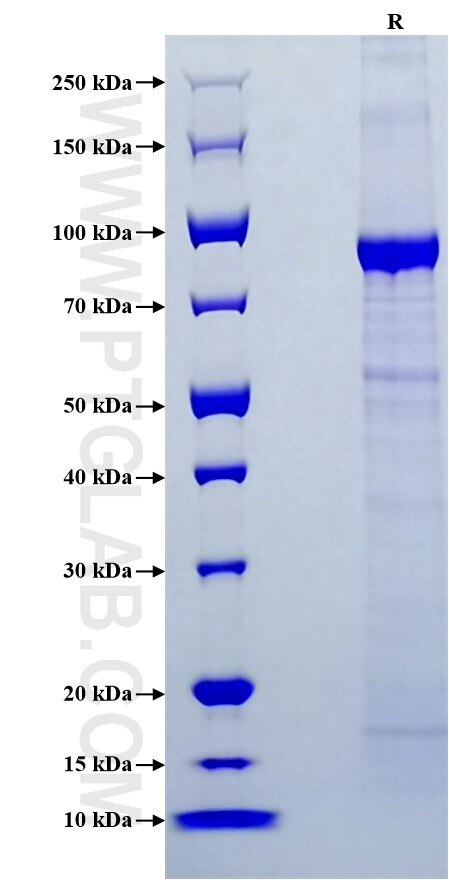
>85 %, SDS-PAGE
Tag
His Tag
Activity
not tested
Cat no : Eg0846
Validation Data Gallery
Product Information
| Purity | >85 %, SDS-PAGE |
| Endotoxin | <0.1 EU/μg protein, LAL method |
| Activity |
Not tested |
| Expression | HEK293-derived Mouse CD31 protein Glu18-Lys590 (Accession# Q08481-1) with a His tag at the C-terminus. |
| GeneID | 18613 |
| Accession | Q08481-1 |
| PredictedSize | 65.6 kDa |
| SDS-PAGE | 85-100 kDa, reducing (R) conditions |
| Formulation | Lyophilized from 0.22 μm filtered solution in PBS, pH 7.4. Normally 5% trehalose and 5% mannitol are added as protectants before lyophilization. |
| Reconstitution | Briefly centrifuge the tube before opening. Reconstitute at 0.1-0.5 mg/mL in sterile water. |
| Storage Conditions |
It is recommended that the protein be aliquoted for optimal storage. Avoid repeated freeze-thaw cycles.
|
| Shipping | The product is shipped at ambient temperature. Upon receipt, store it immediately at the recommended temperature. |
Background
Platelet endothelial cell adhesion molecule-1 (PECAM-1, CD31) is a member of the immunoglobulin gene superfamily of cell adhesion molecules. It is highly expressed on the surface of the endothelium, making up a large portion of its intracellular junctions. CD31 is also present on the surface of hematopoietic cells and immune cells including platelets, monocytes, neutrophils, natural killer cells, megakaryocytes and some types of T-cell. As well as its role in cell-cell adhesion, CD31 functions as a signaling receptor, and is involved in important physiological events such as nitric oxide production, regulation of T-cell immunity and tolerance, leukocyte transendothelial migration and inflammation and angiogenesis.
References:
1. Van Mourik JA. et al. (1985) J Biol Chem. 260:11300–11306.
2. Stockinger H. et al. (1990) J Immunol. 145:3889–3897.
3. Newman PJ. et al. (1990) Science. 247:1219–1222.
4. Newman PJ. (1999)  J Clin Invest. 103:5–9.
5. Newton JP. et al. (1997) J Biol Chem. 272:20555–20563.