
Recombinant Human FLT3 protein (His Tag, hFc Tag)
Species
Human
Purity
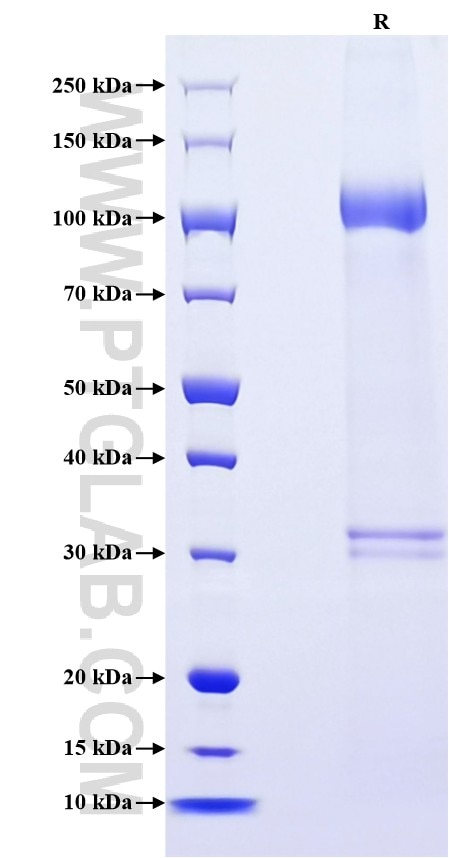
>90 %, SDS-PAGE
Tag
His Tag, hFc Tag
Activity
not tested
Cat no : Eg0171
Validation Data Gallery
Product Information
| Purity | >90 %, SDS-PAGE |
| Endotoxin | <0.1 EU/μg protein, LAL method |
| Activity |
Not tested |
| Expression | CHO-derived Human FLT3 protein Asn27-Asn541 (Accession# P36888-1 ) with a His Tag at the N-terminus and a human IgG Fc Tag at the C-terminus. |
| GeneID | 2322 |
| Accession | P36888-1 |
| PredictedSize | 87.3 kDa |
| SDS-PAGE | 90-125 kDa, reducing (R) conditions |
| Formulation | Lyophilized from 0.22 μm filtered solution in PBS, pH 7.4. Normally 5% trehalose and 5% mannitol are added as protectants before lyophilization. |
| Reconstitution | Briefly centrifuge the tube before opening. Reconstitute at 0.1-0.5 mg/mL in sterile water. |
| Storage Conditions |
It is recommended that the protein be aliquoted for optimal storage. Avoid repeated freeze-thaw cycles.
|
| Shipping | The product is shipped at ambient temperature. Upon receipt, store it immediately at the recommended temperature. |
Background
FLT3, also known as Fms-like tyrosine kinase 3, is a receptor tyrosine kinase involved in hematopoietic cell proliferation and differentiation. It is highly expressed in acute myeloid leukemia (AML) and plays a crucial role in disease progression. FLT3 mutations, particularly internal tandem duplications (ITDs) and tyrosine kinase domain mutations, are associated with poor prognosis in AML. Targeting FLT3 has become an important therapeutic strategy in AML treatment. Additionally, FLT3 ligand is essential for the maintenance and expansion of hematopoietic stem and progenitor cells.
References:
1. Chen, Yun et al. Journal of hematology& oncology vol. 5 (2012): 39.
2. Sironi, Silvia et al. Scientific reports vol. 5 (2015): 17550.
3. Kazi, Julhash U, and Lars Rönnstrand. Physiological reviews vol. 99,3 (2019): 1433-1466.
4. Kennedy, Vanessa E, and Catherine C Smith. Frontiersin oncology vol. 10 (2020): 612880.
5. Negotei, Cristina et al. Journal of clinical medicine vol. 12,20 (2023): 6429.
6. Macečková, Diana et al. Molecular biology reports vol. 51,1 (2024): 521.