
Validation Data Gallery
Tested Applications
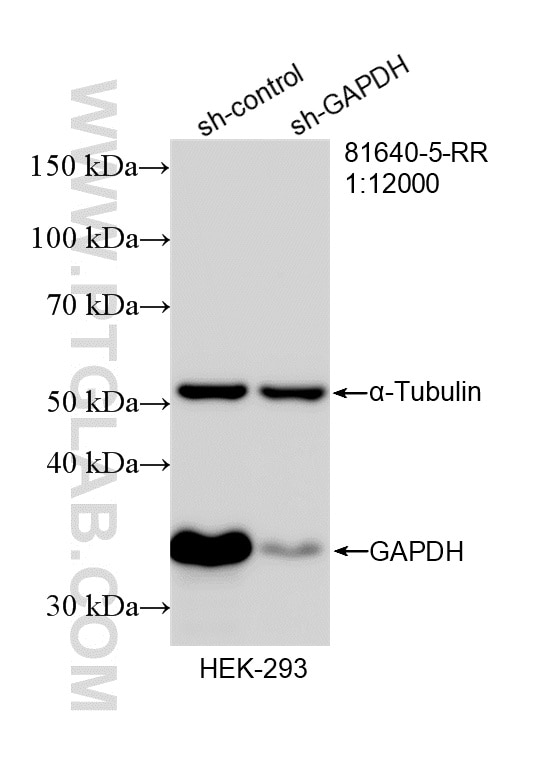
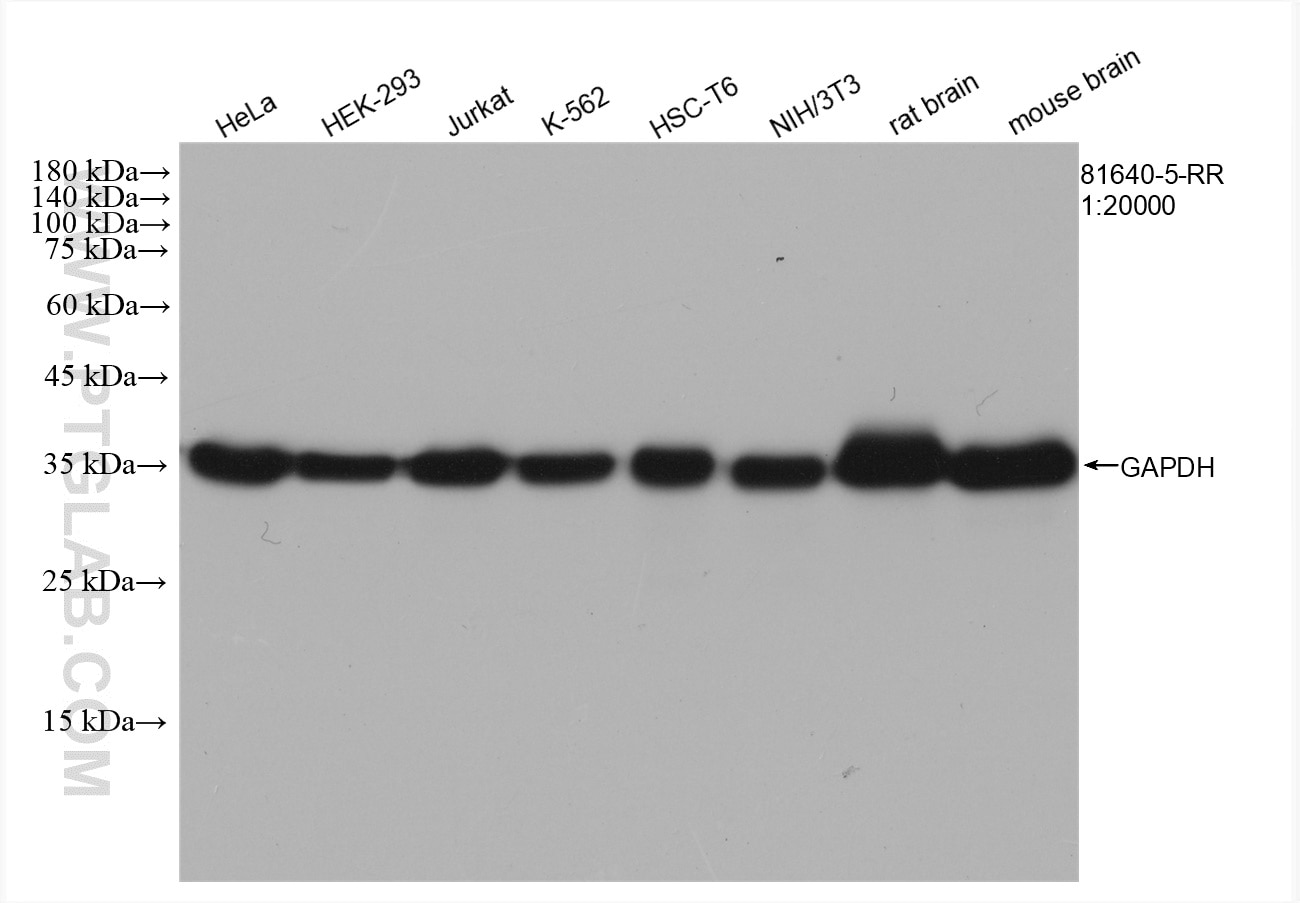
| Positive WB detected in | mouse brain tissue, HEK-293 cells, rat brain tissue, NIH/3T3 cells, HSC-T6 cells, K-562 cells, Jurakat cells, HeLa cells |
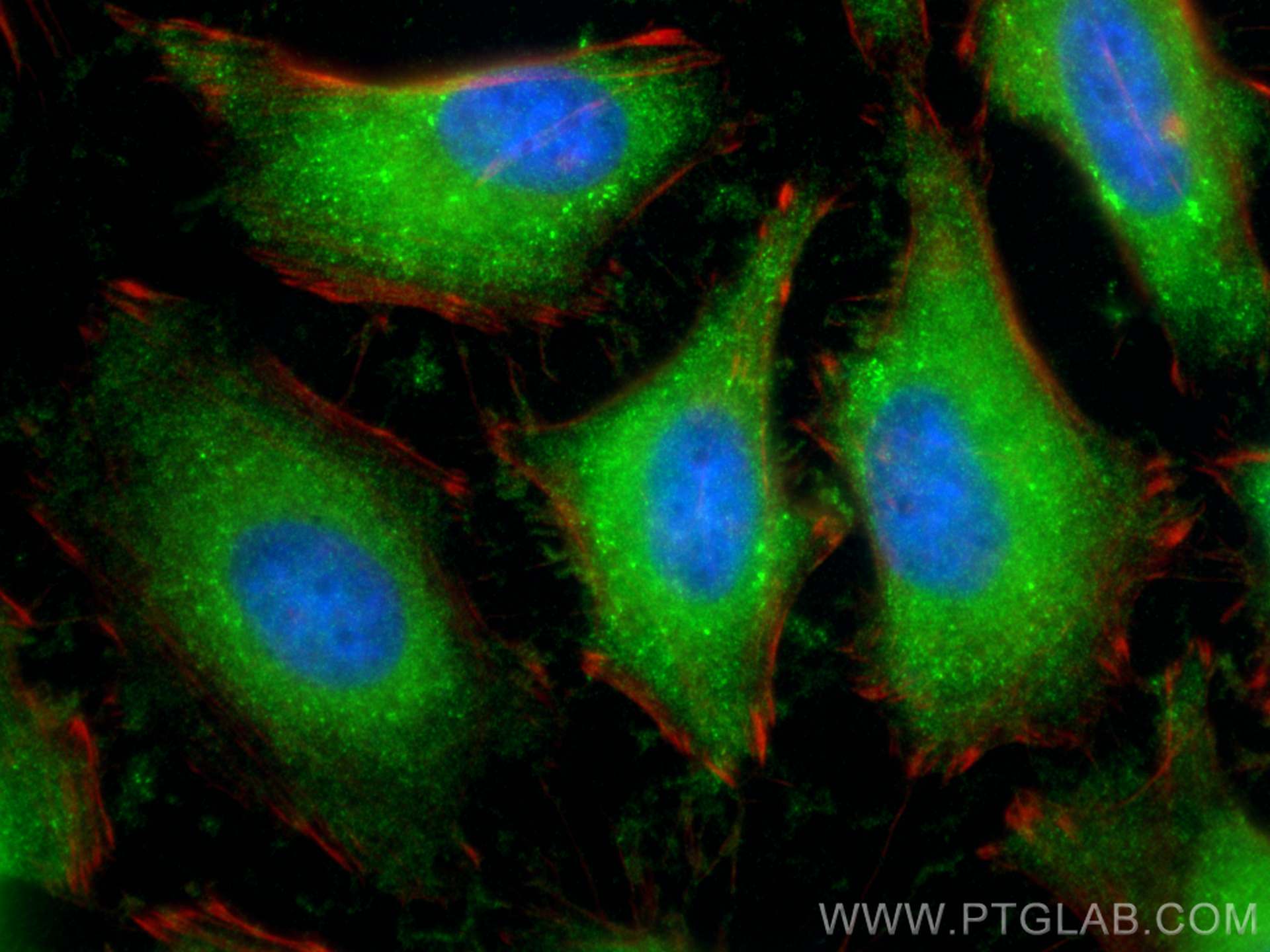
| Positive IF/ICC detected in | HeLa cells |
Recommended dilution
| Application | Dilution |
|---|---|
| Western Blot (WB) | WB : 1:5000-1:50000 |
| Immunofluorescence (IF)/ICC | IF/ICC : 1:500-1:2000 |
| It is recommended that this reagent should be titrated in each testing system to obtain optimal results. | |
| Sample-dependent, Check data in validation data gallery. | |
Published Applications
| WB | See 99 publications below |
| IF | See 1 publications below |
Product Information
81640-5-RR targets GAPDH in WB, IF/ICC, ELISA applications and shows reactivity with human, mouse, rat samples.
| Tested Reactivity | human, mouse, rat |
| Cited Reactivity | human, mouse, rat |
| Host / Isotype | Rabbit / IgG |
| Class | Recombinant |
| Type | Antibody |
| Immunogen |
CatNo: Ag0766 Product name: Recombinant human GAPDH protein Source: e coli.-derived, PGEX-4T Tag: GST Domain: 1-335 aa of BC004109 Sequence: MGKVKVGVNGFGRIGRLVTRAAFNSGKVDIVAINDPFIDLNYMVYMFQYDSTHGKFHGTVKAENGKLVINGNPITIFQERDPSKIKWGDAGAEYVVESTGVFTTMEKAGAHLQGGAKRVIISAPSADAPMFVMGVNHEKYDNSLKIISNASCTTNCLAPLAKVIHDNFGIVEGLMTTVHAITATQKTVDGPSGKLWRDGRGALQNIIPASTGAAKAVGKVIPELNGKLTGMAFRVPTANVSVVDLTCRLEKPAKYDDIKKVVKQASEGPLKGILGYTEHQVVSSDFNSDTHSSTFDAGAGIALNDHFVKLISWYDNEFGYSNRVVDLMAHMASKE 相同性解析による交差性が予測される生物種 |
| Full Name | glyceraldehyde-3-phosphate dehydrogenase |
| Calculated molecular weight | 36 kDa |
| Observed molecular weight | 36 kDa |
| GenBank accession number | BC004109 |
| Gene Symbol | GAPDH |
| Gene ID (NCBI) | 2597 |
| RRID | AB_3086559 |
| Conjugate | Unconjugated |
| Form | |
| Form | Liquid |
| Purification Method | Protein A purification |
| UNIPROT ID | P04406 |
| Storage Buffer | PBS with 0.02% sodium azide and 50% glycerol{{ptg:BufferTemp}}7.3 |
| Storage Conditions | Store at -20°C. Stable for one year after shipment. Aliquoting is unnecessary for -20oC storage. |
Background Information
Glyceraldehyde-3-phosphate dehydrogenase (GAPDH) catalyzes the phosphorylation of glyceraldehyde-3-phosphate during glycolysis. GAPDH participates in nuclear events including transcription, binding RNA, RNA transportation, DNA replication, DNA repair and apoptosis. Being stably and constitutively expressed at high levels in most tissues and cells, GAPDH is considered a housekeeping protein. It is widely used as a control for RT-PCR and also loading control in electrophoresis and Western blotting. GAPDH is normally expressed in cellular cytoplasm or membrane, but can occasionally translocate to the nucleus after the addition of post-translational modifications such as S-nitrosylation. This antibody is raised against full length GAPDH of human origin. It can recognize the 36 kDa GAPDH protein in most cells/tissues. In addition, a band below 36 kDa can always be detected as the isoform or spliced product of GAPDH (PMID: 23885286, 23877755, 19368702). Please note that some physiological factors, such as hypoxia and diabetes, increase GAPDH expression in certain cell types.
Protocols
| Product Specific Protocols | |
|---|---|
| IF protocol for GAPDH antibody 81640-5-RR | Download protocol |
| WB protocol for GAPDH antibody 81640-5-RR | Download protocol |
| Standard Protocols | |
|---|---|
| Click here to view our Standard Protocols |
Publications
| Species | Application | Title |
|---|---|---|
Nat Biomed Eng Targeted clearance of extracellular Tau using aptamer-armed monocytes alleviates neuroinflammation in mice with Alzheimer's disease. | ||
Autophagy AARS2-mediated lactylation of ULK1 promotes autophagy-dependent progression of clear cell renal cell carcinoma. | ||
Nat Commun IRF2BP2 binds to a conserved RxSVI motif of protein partners and regulates megakaryocytic differentiation | ||
J Adv Res Diosgenin activates ERα-dependent PI3K/AKT/GSK3β signaling to enhance brain-derived serotonin and alleviate postmenopausal bone loss. | ||
J Adv Res Fibroblast-derived BMP5 promotes tendon adhesion by inducing bone marrow mesenchymal stromal cells to differentiate into myofibroblasts. | ||
J Nanobiotechnology Lemon-derived nanoparticle-functionalized hydrogels regulate macrophage reprogramming to promote diabetic wound healing |