
Validation Data Gallery
Tested Applications
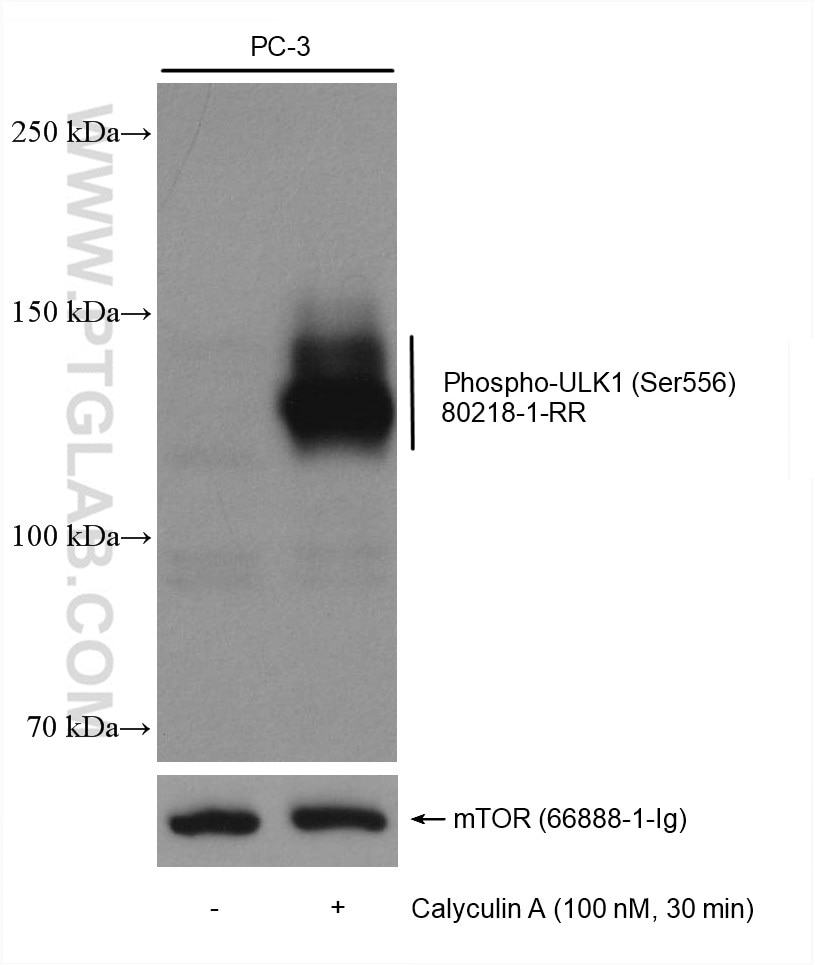
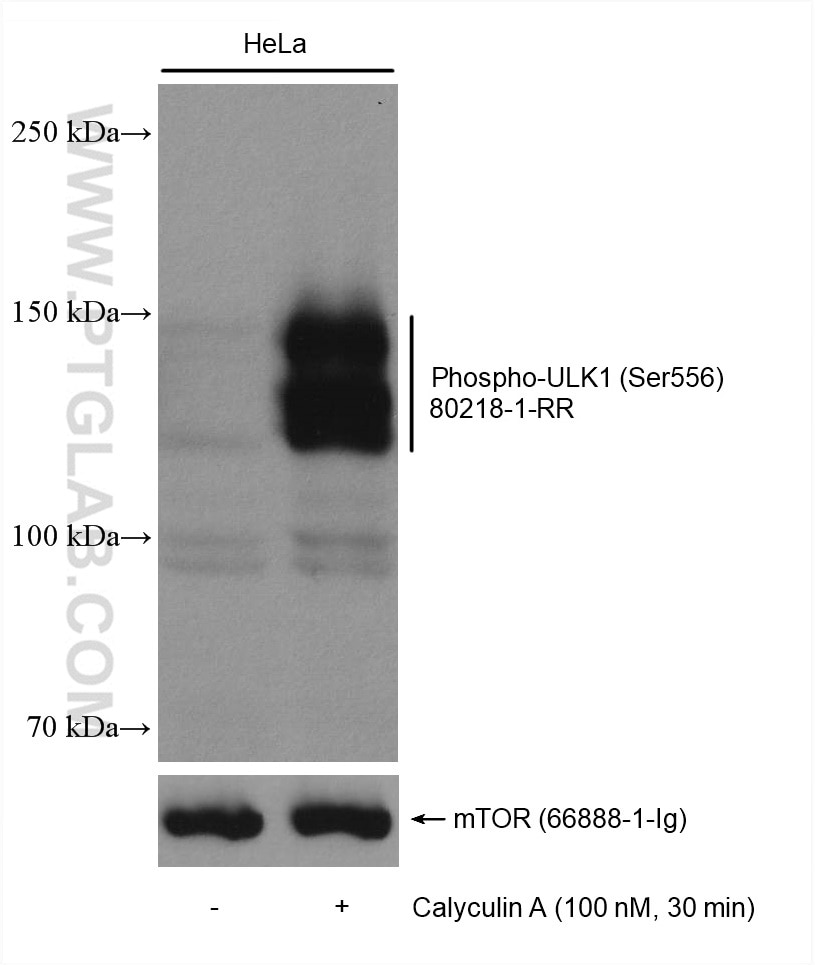
| Positive WB detected in | PC-3 cells, HeLa cells, Calyculin A treated HeLa cells, Calyculin A treated PC-3 cells |
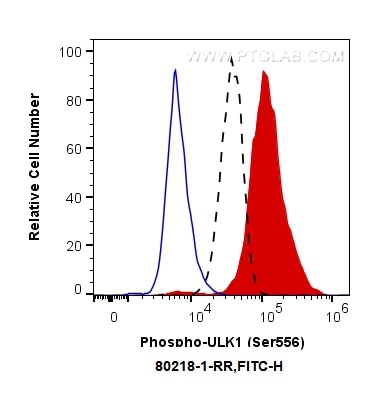
| Positive FC (Intra) detected in | Calyculin A treated PC-3 cells |
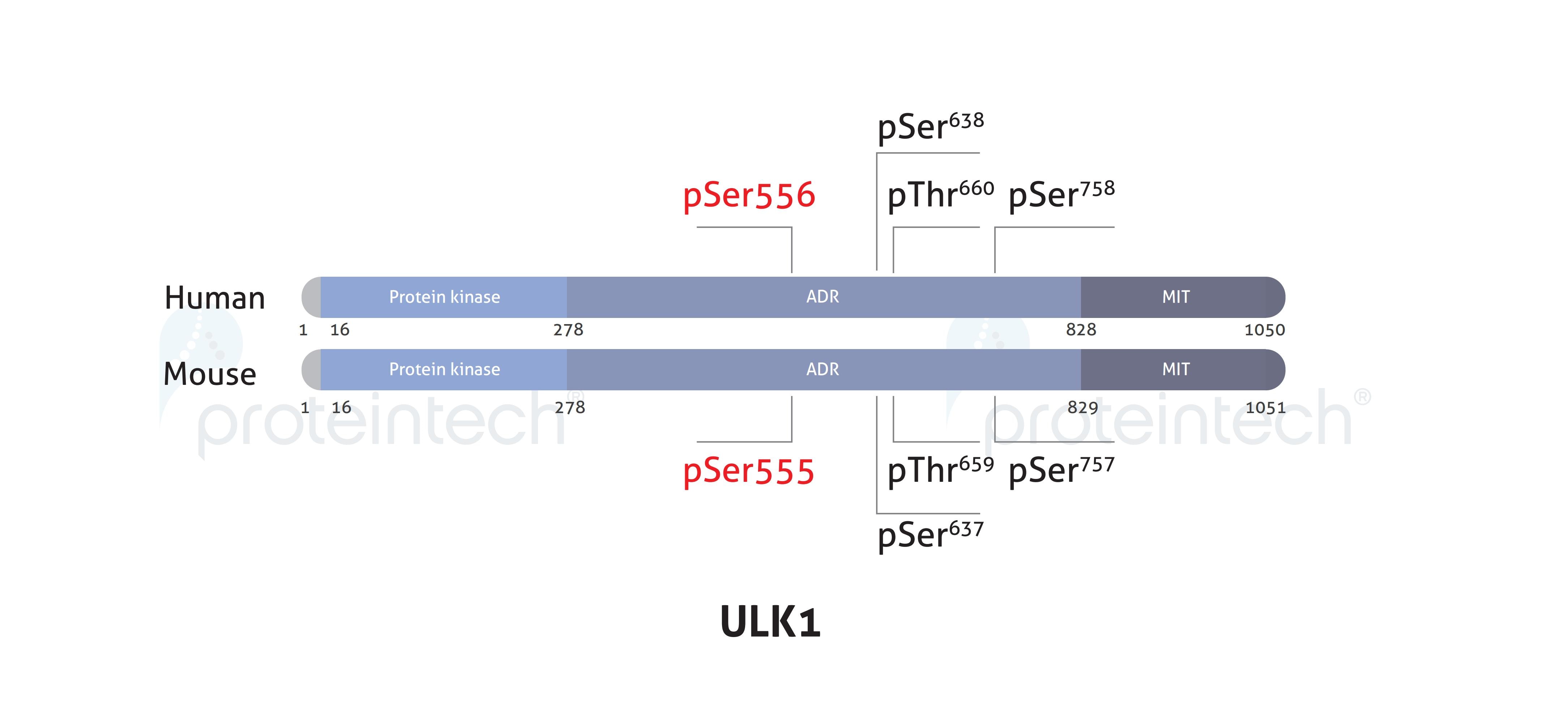
This antibody is equivalent to Ser555 in mice.
Recommended dilution
| Application | Dilution |
|---|---|
| Western Blot (WB) | WB : 1:2000-1:10000 |
| Flow Cytometry (FC) (INTRA) | FC (INTRA) : 0.50 ug per 10^6 cells in a 100 µl suspension |
| It is recommended that this reagent should be titrated in each testing system to obtain optimal results. | |
| Sample-dependent, Check data in validation data gallery. | |
Published Applications
| KD/KO | See 1 publications below |
| WB | See 32 publications below |
| IHC | See 3 publications below |
| IF | See 3 publications below |
Product Information
80218-1-RR targets Phospho-ULK1 (Ser556) in WB, IHC, IF, FC (Intra), ELISA applications and shows reactivity with human samples.
| Tested Reactivity | human |
| Cited Reactivity | human, goat, duck |
| Host / Isotype | Rabbit / IgG |
| Class | Recombinant |
| Type | Antibody |
| Immunogen |
Peptide 相同性解析による交差性が予測される生物種 |
| Full Name | unc-51-like kinase 1 (C. elegans) |
| Observed molecular weight | 140 kDa |
| GenBank accession number | NM_003565 |
| Gene Symbol | ULK1 |
| Gene ID (NCBI) | 8408 |
| RRID | AB_2918877 |
| Conjugate | Unconjugated |
| Form | |
| Form | Liquid |
| Purification Method | Protein A purification |
| UNIPROT ID | O75385 |
| Storage Buffer | PBS with 0.02% sodium azide and 50% glycerol{{ptg:BufferTemp}}7.3 |
| Storage Conditions | Store at -20°C. Stable for one year after shipment. Aliquoting is unnecessary for -20oC storage. |
Background Information
Unc-51-like-kinase 1 (ULK1) is a target of both the mechanistic target of rapamycin (mTOR) and AMP activated protein kinase (AMPK), whose role is to facilitate the initiation of autophagy in response to starvation. ULK1 is phosphorylated on serine 638 and 758 sites by mTOR in nutrient-rich conditions, inhibiting ULK1 activation by disrupting its binding to AMPK. Upon glucose starvation, dissociation of mTOR from ULK1 and phosphorylation by AMPK leads to the activation of ULK1 activity. The S556 site of ULK1 is one of the major AMPK-dependent phosphorylation sites. (PMID: 30517873, PMID: 21258367)
Protocols
| Product Specific Protocols | |
|---|---|
| WB protocol for Phospho-ULK1 (Ser556) antibody 80218-1-RR | Download protocol |
| Standard Protocols | |
|---|---|
| Click here to view our Standard Protocols |
Publications
| Species | Application | Title |
|---|---|---|
Cell Death Dis IKCa channels control breast cancer metabolism including AMPK-driven autophagy | ||
J Hazard Mater Graphene oxide disrupted mitochondrial homeostasis through inducing intracellular redox deviation and autophagy-lysosomal network dysfunction in SH-SY5Y cells. | ||
Cell Death Discov AMPK is dispensable for physiological podocyte and glomerular functions but prevents glomerular fibrosis in experimental diabetes.
| ||
Environ Res Chronic microcystin-leucine-arginine exposure induces osteoporosis by breaking the balance of osteoblasts and osteoclasts | ||
Free Radic Biol Med CAB39 promotes cisplatin resistance in bladder cancer via the LKB1-AMPK-LC3 pathway | ||
J Anim Sci Biotechnol Sulforaphane prevents LPS-induced inflammation by regulating the Nrf2-mediated autophagy pathway in goat mammary epithelial cells and a mouse model of mastitis |