
Validation Data Gallery
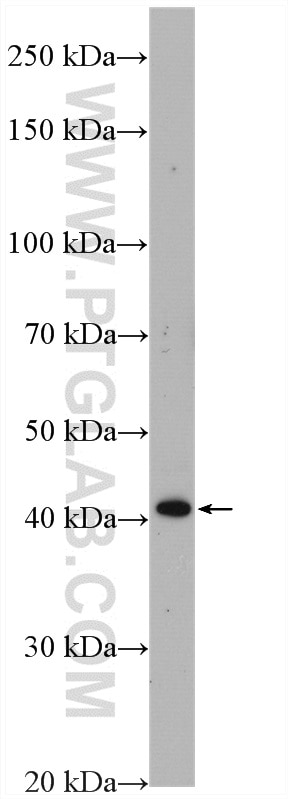
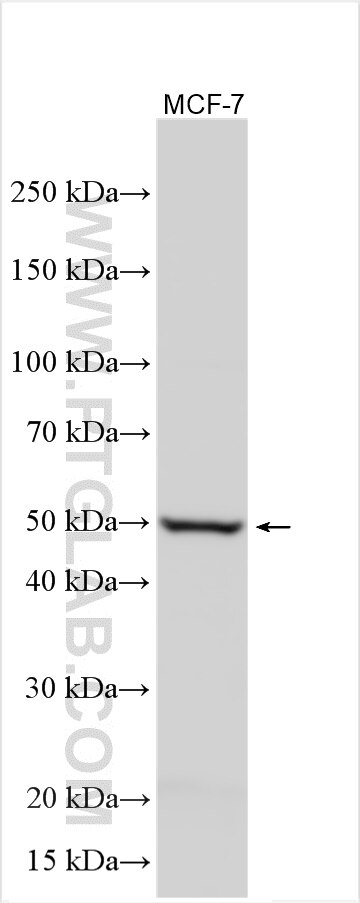
Tested Applications
| Positive WB detected in | fetal human brain tissue, MCF-7 cells |
Recommended dilution
| Application | Dilution |
|---|---|
| Western Blot (WB) | WB : 1:500-1:1000 |
| It is recommended that this reagent should be titrated in each testing system to obtain optimal results. | |
| Sample-dependent, Check data in validation data gallery. | |
Published Applications
| WB | See 70 publications below |
| IHC | See 2 publications below |
| IF | See 2 publications below |
Product Information
26744-1-AP targets WNT3A in WB, IHC, IF, ELISA applications and shows reactivity with human, mouse samples.
| Tested Reactivity | human, mouse |
| Cited Reactivity | human, mouse, rat, zebrafish |
| Host / Isotype | Rabbit / IgG |
| Class | Polyclonal |
| Type | Antibody |
| Immunogen |
CatNo: Ag25051 Product name: Recombinant human WNT3A protein Source: e coli.-derived, PET30a Tag: 6*His Domain: 250-350 aa of BC103921 Sequence: RGWVETLRPRYTYFKVPTERDLVYYEASPNFCEPNPETGSFGTRDRTCNVSSHGIDGCDLLCCGRGHNARAERRREKCRCVFHWCCYVSCQECTRVYDVHT 相同性解析による交差性が予測される生物種 |
| Full Name | wingless-type MMTV integration site family, member 3A |
| Calculated molecular weight | 352 aa, 39 kDa |
| Observed molecular weight | 42 kDa |
| GenBank accession number | BC103921 |
| Gene Symbol | WNT3A |
| Gene ID (NCBI) | 89780 |
| RRID | AB_2918108 |
| Conjugate | Unconjugated |
| Form | |
| Form | Liquid |
| Purification Method | Antigen affinity purification |
| UNIPROT ID | P56704 |
| Storage Buffer | PBS with 0.02% sodium azide and 50% glycerol{{ptg:BufferTemp}}7.3 |
| Storage Conditions | Store at -20°C. Stable for one year after shipment. Aliquoting is unnecessary for -20oC storage. |
Background Information
WNT3A belongs to wingless-type MMTV integration site family, and abnormal Wnt signalling is often associated with severe human diseases, including cancer, osteoporosis and other degenerative disorders. WNT3A is a secreted glycoprotein that is involved in both canonical and non-canonical Wnt signaling pathways. The canonical Wnt pathway, also known as the β-catenin-dependent pathway, regulates gene expression by stabilizing β-catenin, which then translocates to the nucleus and interacts with transcription factors like TCF/LEF. It's shown to promote trophectoderm formation in embryonic stem cells. It's reported that the canonical Wnt/β-catenin signaling pathway also contributes to the carcinogenesis and progression of lung cancer cell lines. The non-canonical pathways, which are β-catenin-independent, are involved in cytoskeletal organization and cell polarity.
Protocols
| Product Specific Protocols | |
|---|---|
| WB protocol for WNT3A antibody 26744-1-AP | Download protocol |
| Standard Protocols | |
|---|---|
| Click here to view our Standard Protocols |
Publications
| Species | Application | Title |
|---|---|---|
Bioact Mater Magnesium ion implantation enhances the osseointegration and vascularization of 3D-Printed CoCrMo alloy scaffolds for load-bearing orthopedic applications. | ||
Autophagy WNT2B impairs endosomal trafficking via WASHC5 to inhibit autophagy: a novel non-secretory WNT pathway. | ||
ACS Nano Flowerbed-Inspired Mg-Loaded Scaffold Accelerates Critical-Sized Bone-Defect Repair by Reprogramming the Microenvironment. | ||
Adv Sci (Weinh) CHB-Induced Immune Zonation Chaos Elicited LXRα-mediated Lipid Metabolism Disorders in Kupffer Cells to Induce Cancer Stem Cell Formation. | ||
Adv Sci (Weinh) Photothermal Coating on Zinc Alloy for Controlled Biodegradation and Improved Osseointegration |